an advisory board for your online store
Seven Chairs.
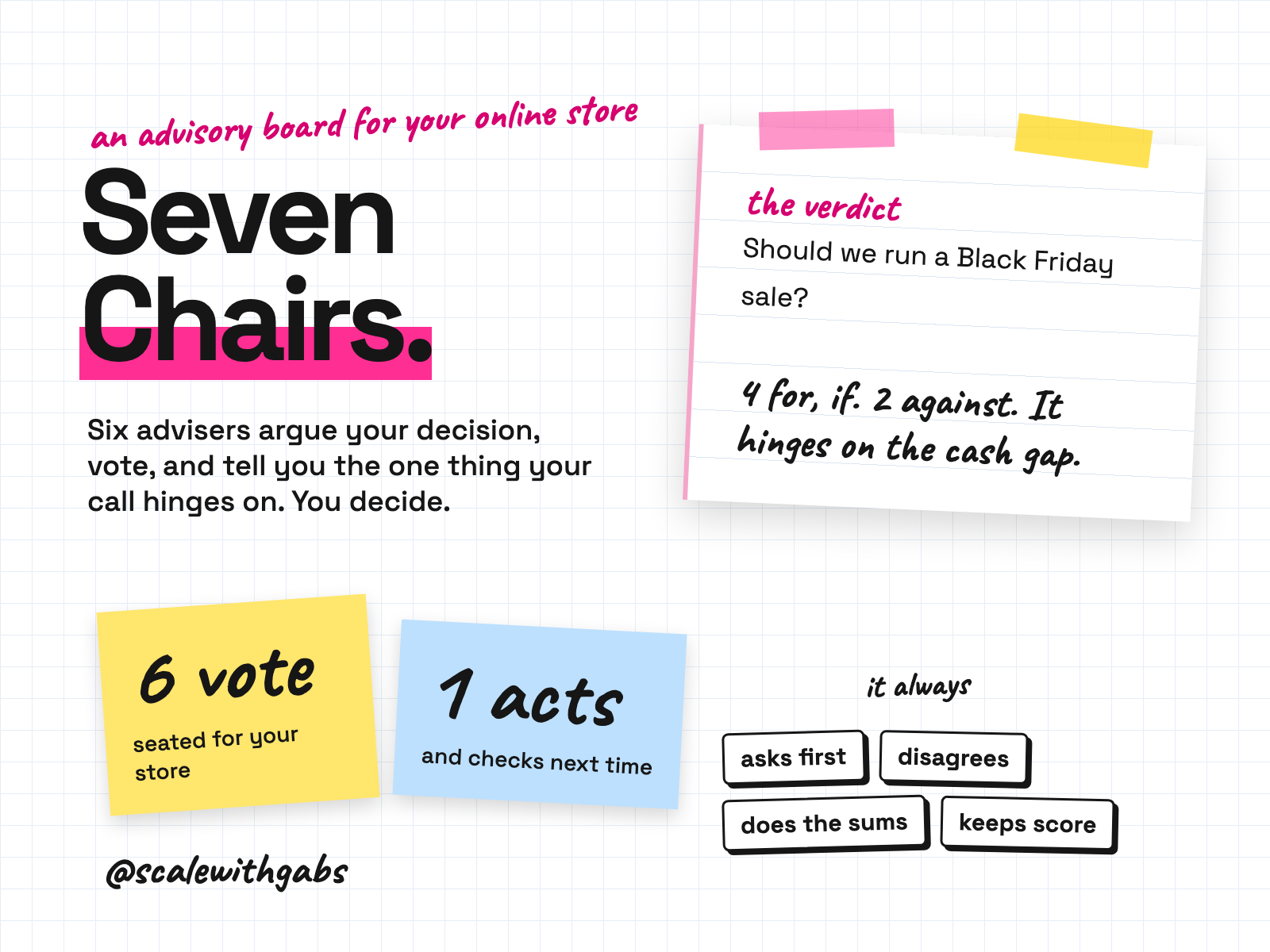
Should we go on Amazon. Should we discount for Black Friday. Should we take the wholesale order that eats our cash for a quarter. Six advisers who know your store argue it out in front of you, vote, and name what your call hinges on. Then a seventh turns your decision into dated actions and checks up on you.
built for
- Claude
- ChatGPT
- Gemini
- Codex
- Cursor
- GitHub Copilot
Why I built it.
I was not a very good opponent
I've run an ecommerce brand since 2020, and the loneliest part was never the work. It was the decisions. Should we go on Amazon. Should we discount for Black Friday when the boutiques hate it. I had nobody to argue with at 10pm, so I argued with myself, and I was not a very good opponent.
So I built a board. Six advisers with fixed jobs: one to find the hole in the idea, one to speak as my customer, one to do the sums, one to check the facts, one to protect the brand, and one to think in years.
It changed how I decide. Then I did what I always do: I wrote it down so you could use it, and I made it ask about your business first, because advice that doesn't know your margin is a blog post.
I won't tell you it makes better decisions. Nobody can promise that. It makes sure you've heard the argument before you make the call.
What it does.
- Asks about your business first. 39 questions in about 20 minutes, mostly tap to choose, or an 8 question quick start.
- Seats six advisers for your store from a bench of sixteen. Keep them, swap them, rename them.
- Argues in front of you and votes. For, Against, or For, if, with the condition named. At least one of them always disagrees.
- Names the one thing your call hinges on, and what would change the verdict.
- Turns your decision into a plan. Three to seven dated actions with an owner and a done when, the first one doable in 24 hours.
- Checks up on you next time. It keeps a decision log and opens with what you promised to do.
Who it's for.
and who it is not for
- Owners of online stores on any platform: Shopify, WooCommerce, BigCommerce, marketplaces.
- Owners making real calls about products, pricing, channels, stock, suppliers and marketing, mostly alone.
- Owners who already use an AI tool and are tired of it agreeing with them.
- Owners who want to be held to what they decided.
Not for: anyone who wants a tool to decide for them, spend money or change things in their store. It never does any of that. It also won't give legal, tax or financial advice, and says when to see a professional.
How it works.
- 1It gets to know you, once. Your numbers, your customers, your never-do list. Then it plays it back: "Did I get that right?"
- 2You ask your question. In one sentence. It sharpens vague ones, restates loaded ones and tells you if the decision is easy or hard to reverse.
- 3Six advisers argue. The Skeptic, the Customer, the Operator, the Analyst, the Brand Keeper and the Long Game, each in their own voice.
- 4They vote. The verdict gives the tally, the strongest case each way and the one thing it hinges on.
- 5You make the call. Go, go with the conditions, not now, or I need more information. Only you decide.
- 6The Executer makes the plan. Dated actions and a review date. Next session it asks what happened.
See it in action.
tap one to see it full size
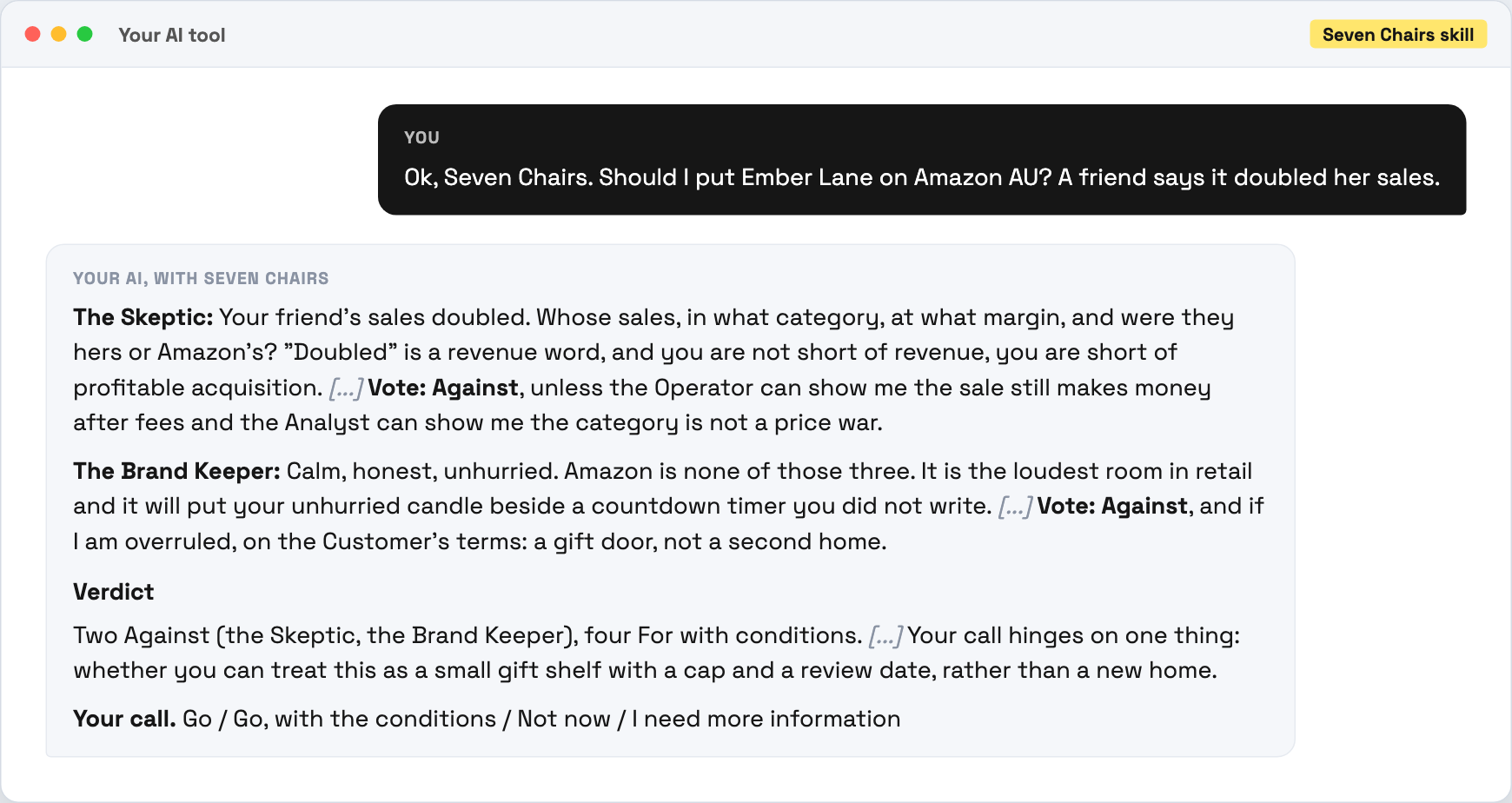
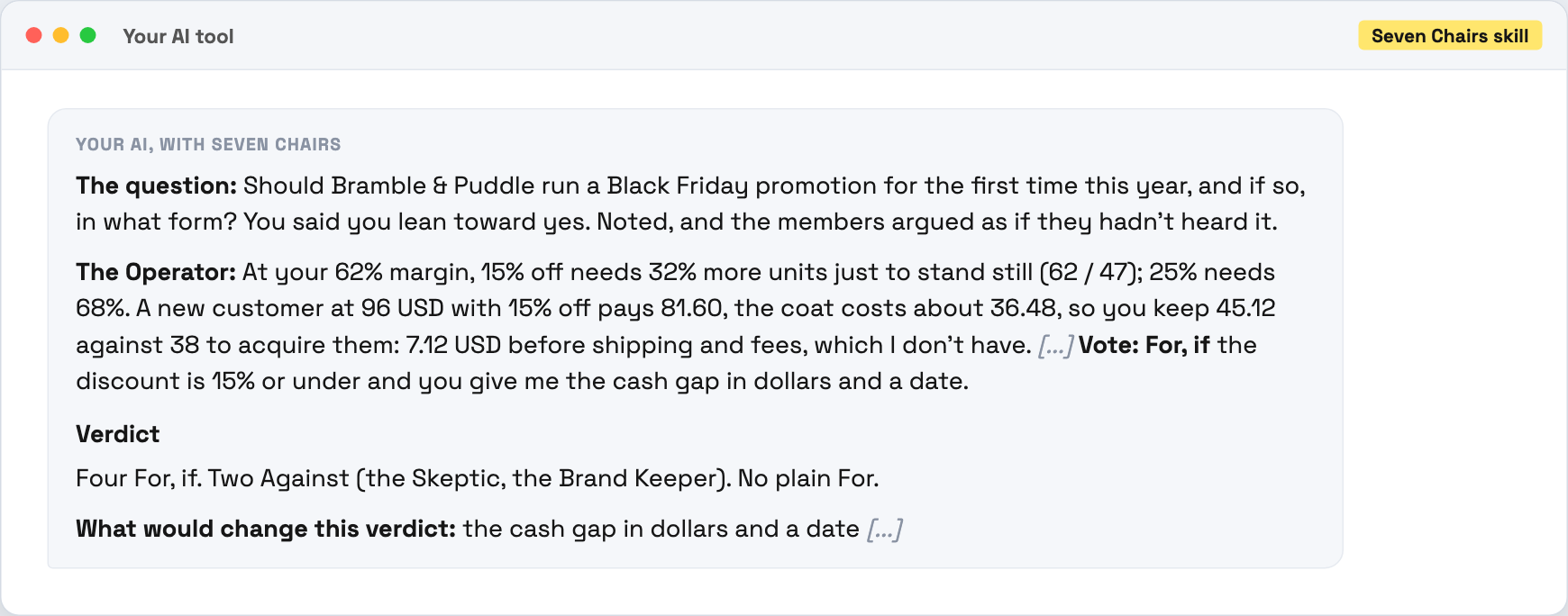
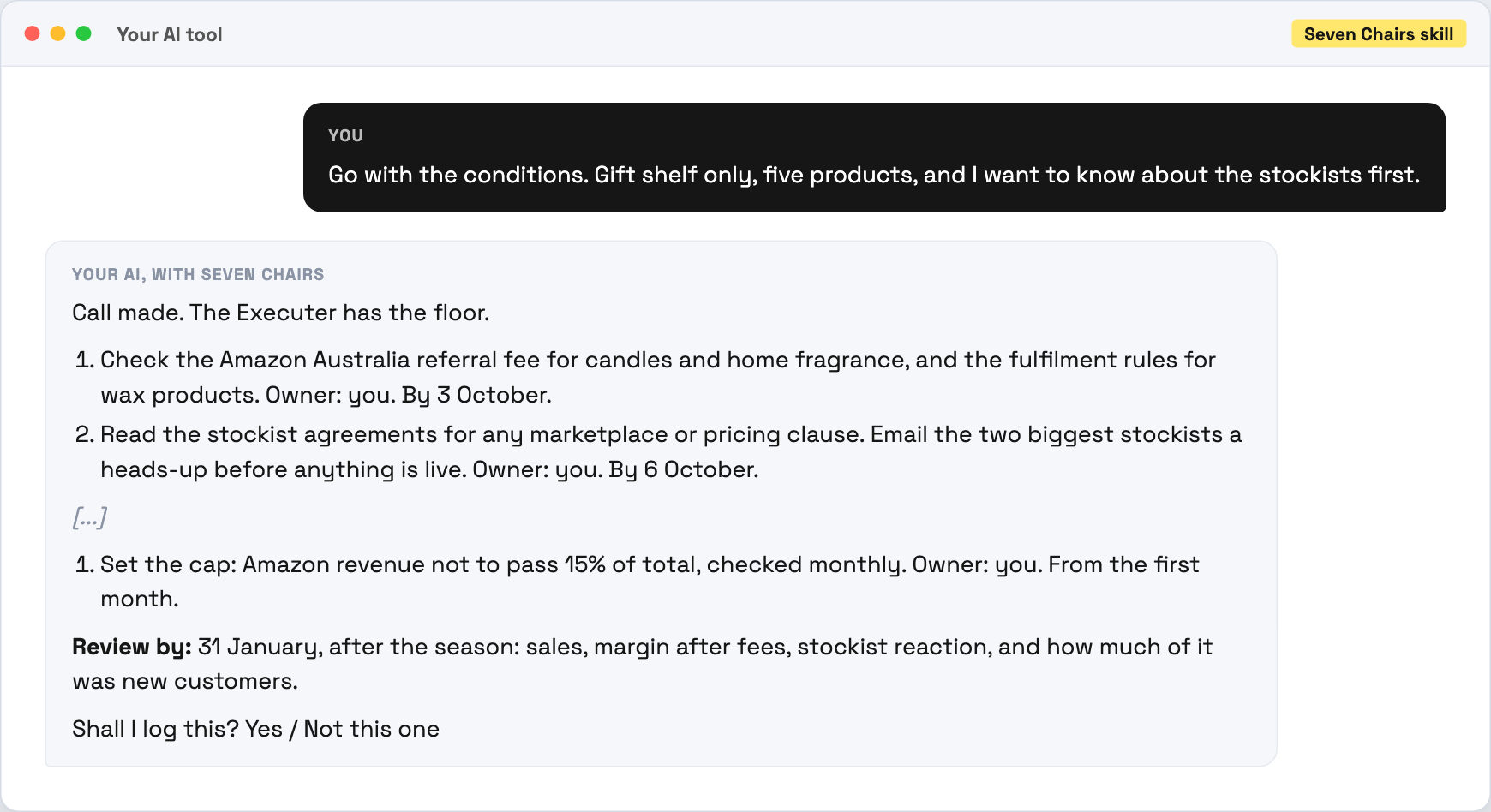
These are sample sessions that ship with the kit, on invented stores with invented numbers, so treat none of the figures as a real benchmark. Trimmed to fit, marked with [...]. Your board will sound like your business.
How to use it.
copy, paste, done
- 1Install it in your tool. In Claude Code, Codex, Cursor, Gemini CLI or Copilot you paste one message. In ChatGPT, Gemini or claude.ai it runs as a Project or a Gem with one file.
- 2Say "Set up my board." It makes three promises, then asks about your business. Full setup takes about 20 minutes, the quick start about 5.
- 3Bring it a real decision. Ask it anything you're stuck on. Read the argument, then make your call.
the first thing you say
Set up my board.
Then just say things like
convene the board on...a full session on your questionquick takethree advisers, two lines eachdeep sessioneach adviser votes without seeing the otherswhat would the Operator say?just one adviserpre-mortemimagine it failed, and find out why firstwhat's openevery logged decision, overdue firstbrief my partnera short note to forward to a co-owner or accountantgive me the strongest case againstwhen you want it to push back harder
Built for your AI tool.
best on the strongest model you have
Where I have run it: By reading the skill files on invented stores. It is built to the open Agent Skills standard, and each install route follows that tool's own documentation, checked September 2026. I name a tool as tested only once it has passed my cross-tool test.
Never used AI?
good. start here.
Good. You're exactly who I wrote the lessons for.
Every download comes with a How to use page you can open before you even unzip anything. Pick your AI tool and it shows you where to click and what to paste, one step at a time. If you can copy and paste, you're qualified.
Then there's a short lesson that walks you through your first real session: what to say, what a good answer looks like, and what to do when it isn't. No code, no jargon, no Terminal.
Still stuck? Every download has an it didn't work section for each tool, and my email. Or grab an hour with me and we'll set it up together.
What you get.
- The Seven Chairs skill, for Claude Code, Codex, Cursor, Gemini CLI and Copilot.
- A one-file edition for ChatGPT, Gemini and claude.ai Projects.
- The intake: 39 questions, or an 8 question quick start.
- A bench of sixteen advisers, four session modes and the decision log.
- The How to use page and a 15 minute lesson in seven parts.
- A worked example of a full session, start to finish.
Good questions.
tap a question to open it
Does it connect to my store or see my data?
No. It knows only what you tell it. Your profile and decision log are saved on your own computer, or inside your project's instructions in the chat apps. It never sends them anywhere.
Will it make the decision for me?
No, and it's built not to. Every session ends with a vote, the strongest case each way and the one thing your call hinges on. Then it asks for your call. The plan only exists after you decide.
Is it several different AIs?
No. It's six perspectives with fixed jobs and voices, run by your own AI tool and tuned by your answers. For big decisions there's a deep session where each adviser votes without seeing the others.
Why does it ask so many questions first?
Because advice that doesn't know your margin, your customer and your never-do list is a blog post.
Do I need to be technical?
No. You never open code, a Terminal or a file.
Do I need a paid AI plan?
I recommend running these on a paid plan for your AI tool, like Claude Pro, ChatGPT Plus or Google AI Pro. Free plans cap how much you can send, how many files a project can hold and which model you get, and these skills do their best work on the strongest model your tool offers.
Do you see my business or my drafts?
No. It runs in your own AI tool, under your own account and that provider's terms. There's no server on my side, so nothing comes to me.
How do I get it?
Pay once and get your download straight away, with a How to use page and a licence key by email that you paste in when you install. One licence is for one business.
Do I get updates?
Yes. When a new version is out you get an email with the new download and a message to paste that updates it without losing your settings.